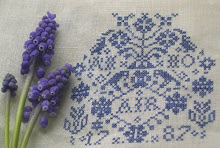
Regular Needleprint gifts for Mary Wigham SAL photos

Regular Needleprint gifts for Mary Wigham SAL photos
Share your work in progress with your Head Girls and a Needleprint gift could be landing on your doorstep. Simply click on the Ackworth School Memory Book Thread Winders above to tell us about your stitching progress.

Wednesday, 11 November 2009

Knit Cosy Quaker Mittens - and a Sweater Too!


A few weeks ago when I shared a free download of knitted muffatees from Swaledale Museum, I asked if anyone could come up with a Quaker version. Cynthia Wasner from Oregon has done more than that. Not muffatees, but the delightful mittens you see here. And that is not all!

Cynthia has also designed this wonderful Quaker themeed sweater and I'm told patterns for both will be available in about a week's time from
Norsk Needlework

Tuesday, 10 November 2009

Symbolism of Serpent or Snake

The portraits and dresses of Queen Elizabeth I are a maze of symbolism and symbolic motifs, many of which would lead us a merry dance into blind alleys. The important thing is that they do demonstrate that symbolism was all important, and that embroidery employed a silent language which, like ancient oracles, could be interpreted with a certain amount of intended ambiguity. We have looked before at the serpent which can signify wisdom on one hand or deception on the other. In the Rainbow portrait by Isaac Oliver of 1600, there is no doubt at all that we are intended to see the serpent on Elizabeth's sleeve. It could be a symbol of wisdom..... or it could be her birth sign. Elizabeth was born on 7 September 1533 which makes her, like me, a Virgo. Recent historical research has sought to part the curtains on Princess Elizabeth's early bedroom life and it appears that claims to her virginity are in serious doubt.

In this earlier Hardwick portrait commissioned by Bess of Hardwick in 1599 of Nicholas Hilliard (Bess is also said to have embroidered this skirt), serpents are again to be seen. Perhaps there were rumours and innuendos about her purported virginity in her own life time, and perhaps this is her response - a queen born under the sign of Virgo is a Virgin queen! The serpent is the symbol of Virgo in Chinese astrology...as her astrologer, Dr John Dee, who cast her charts would, no doubt, have told her.

Monday, 9 November 2009

Clox on Sox - Christmas Infinity Download


I made a resolution this year that I would be better prepared for Christmas. I don't know if November is too late to start, but it is better than January. Over the year I have been squirrelling away special little delights to give as gifts, so I am not starting from square one, which is a great boost. A couple of weekends ago, while looking through some 16th century pattern books, I found some lovely patterns for stocking clocks, and I thought what could be a better decoration for Christmas Stockings than some pretty Renaissance clocks? It took me a weekend to make these in between other work, so if you are looking for inspiration for a gift exchange, then here you are. I have made up some scrolls of linen and thread to go with little patterns I have designed, and there are punch spices, little tubes of gold needles, and then all it will need is a walnut or almond for the toe! If you would like an Infinity PDF and JGG download to make your own for $8, just click here.
(You might not be able to see on your screen, but the pattern comes with sock outlines for the clock designs.) There is an on line German museum dedicated to hosiery:
click here to visit.

Sunday, 8 November 2009

Viji's Finished Mary Wigham Takes a Tour and Meets Gandhi


You may remember Viji from Chennai in India who is was stitching her Mary Wigham on blue Aida - well she has finished. Congratulations Viji!

She tells us: 'At last, I completed the Mary Wigham Sampler. I am attaching photographs of Mary Wigham's in front of the Gandhi Monument on the beach at Pondicherry, a few photographs of Mary in Mahabalipuram (a sculpture city). It is also called a Mamallapuram. The Five Rathas are known as Pandava Rathas also. The Lion and Elephant in front of these caves are sculpted wonders as they are carved out of a single stone. Victor was able to take phtographs of Mary's Sampler in front of these lovely places. I enjoyed stitching Mary's Sampler so much. I have no words to thank you for bringing Mary close to people like me who stay so far and would never had an opportunity to know about her but for your efforts.'

It is lovely to share your Mary Wigham, Viji, and your stitching companionship. I am so impressed by your husband's placing something beneath your sampler to keep it clean while taking his pictures - that is really thoughtful.

Saturday, 7 November 2009

Sources for Tulips

I have a great love for the tulips which figure at the top of this Goodhart sampler (G82). They led me to another sampler in the Fitzwilliam Museum, Cambridge (T15-1952) and allowed me to posit an identity, Mary Basham, for the maker of the Goodhart sampler. It is always a wonderful moment, as some you may have experienced for yourselves, when some seemingly small clue allows you to 'return' a sampler or other artifact to its maker. There are a number of sources for the tulip on Mary's sampler stitched in 1778, but there is something about this one of 1730 - the subscribers' page from Robert Furber's Twelve Months of Flowers - which caught my eye. Possibly it is simply a deception of the tulips' placement at the top corners of a border framing a rectangular centrepiece, for no other florals are matched. Robert Furber was 'Gardiner' at Kensington and the illustrations in his catalogue were painted by Antwerp artist Pieter Casteels, and be inspiration to the Dutch-born still-life paintings Jacob van Huysums.


Friday, 6 November 2009

The Needle Work-Book of Nelly van Maarseveen


I love beautiful needle work-books and many years ago I found this book in my aunt's collection. To my mind, it is one of the most delightful. Originally made in 1886, it was republished in facsimile form in 1981 and is still readily and cheaply available via internet second hand book shops in the Netherlands. It is well worth the hunt and the postage!

Thursday, 5 November 2009

Amager Blue - Conceived in China?


Or conceivably it could be the other way around? While travelling last month I came across again a book published in 1978 called Blue and White, The Cotton Embroideries of Rural China by Muriel Baker and Margaret Lunt. I think first time round, in my uneducated state, I had dismissed the book for what I considered very simplistic and uninspiring charted extracts, never bothering, as a consequence to delve into the text. My loss. But sometimes learning is a cyclical thing and it is only when you have come to appreciate something else that you can return and find hidden enjoyment in what you have previously discounted. There is a time for things to make sense. And I had had to wait until I had discovered the fabulous Amager stitched panels for these blue Chinese folk embroideries to make sense. Amager is a Danish island a bus ride away from Copenhagen. Until very recently it was a self contained, self regulating Dutch enclave which had been plucked by the King of Denmark out of the Netherlands in the 1520s and dropped down on fertile ground in order to stock the court pantry with good green vegetables as only the Dutch know how. They have such a totally fascinating history - they maintained their customs, their speech, their dress and embroidery over the centuries. When I visited Amager, I was totally struck by their wonderful indigo blue embroideries teeming with mermaids, lions, horses and angels. What most impresses me is the superb gestalt of their designs in which all these apparently chaotic motifs are positioned, not at random, but in such a studied way with respect to their neighbouring motifs that the overall composition comes together in a beautiful close harmony. This effect is enhanced by the internal patterns that powder the large motifs. It is incredibly distinctive, and although I have seen some of their motifs elsewhere - for example, the paired angels appear on Vierlander samplers - I have not seen that particular approach to design anywhere else. Until I looked more carefully at the Chinese cotton embroideries book again. This is very much work in progress for me at the moment. There was a Danish East India Company with warehouses on Amager which traded with South East Asia - and the question is, did one trading country influence another? The Needleprint Amager Panel 1797 Chart contains more history. Because of the present postal strike, I have decided to make a black and white PDF version available as a download for those of you who are unable to buy the physical chart at your LNS. Just click here for the Amager Panel PDF costing $10. By clicking on the little Chinese extract below which I have charted, you should be able to have a sufficiently large pattern from which to work. If you are a Needleprint Infinity user, you can click here to download a free editable version. (Remember you need to choose the option to save and not open the file as you can only open it from inside Cross Stitch Designer.)


Wednesday, 4 November 2009

My Dear Father - Free Infinity Download

I was delighted to hear from Sampler Central today that the V&A Museum now have their sampler collection on-line! This is just what I dreamed of five years ago, now we can really start to put the sampler jigsaw pieces together to help with our researches.
I have chosen this sampler from the V&A collection to show you because it makes me smile as I remember my friend's father. As a young man he and his best friend escaped from Alsace, France at the beginning of the war. Together they somehow made their way south, down to the Pyrenees, from where they crossed the border into Spain. They spent a year in a Spanish prison - as many fleeing French did, they escaped again this time to England and from there got themselves back into France again to work with the Resistance. In the final days of the war they scaled Strasbourg Cathedral under sniper fire to fly the French flag from the spire. They were subsequently awarded the Legion d'Honneur.

I think when I composed this excerpt I was rather wishing I had trumpeted these words to my father, louder and more often! To honour fathers everywhere, here is a little charted editable Infinity excerpt to download. If you prefer a colour PDF version to download, just click here. I am sorry I didn't keep a record of the colours, but I am sure you will have great fun choosing your own.

Tuesday, 3 November 2009

A Norwich Darned and Embroidered Shawl Counterpane

Thank you for supporting Carrow House with your purchase of samplers charted by Philippa Sims. Here you can see an example of the good work undertaken by the Norfolk Costume and Textile Association. This unique, embroidered counterpane needed conservation and the NC&TA raised the necessary funds of £10,980 to complete its conservation in 1997. Conservation is expensive and now you can see the significant role played by your purchases - every purchase does make a difference. But I'll let Philippa Sims who is a member of the NC&TA and a volunteer at Carrow House tell you its interesting story.
'Folded away in a museum cardboard box is a piece of local textile history with royal and heraldic interest. Made in 1792 by the Norwich firm of Harvey and Knights this ten foot square Counterpane is a splendid - and possibly the earliest - example of embroidered shawling. It was donated soon after the opening of Strangers’ Hall Museum in the 1920s but sadly all details of the donor are lost. However, it is known to have been a prototype of a counterpane made for Queen Charlotte and won the Silver Medal of the Royal Society of Arts. Queen Charlotte and the Princesses visited the Norwich Shawl Exhibition in New Bond Street, London and perhaps this counterpane was on show.
Made with silk warp and wool weft, the design would have been block-printed on to the fabric and then embroidered. In the centre you can see the arms of George III with magnificent athletic supporters. The fleur de lis was included in the Royal Arms until George III abandoned the title of King of France in 1801, the arms of Hanover are two leopards for Brunswick, lion among hearts for Luneburg and the white horse for Westphalia. The crown above was the badge of the Arch-Treasurer of the Holy Roman Empire. On four small corner shields are fleurs de lis, Scottish lion, Irish harp and three cuddly looking leopards! The embroidery in polychrome silks resembles weaving but is actually a very close darning stitch, creating some wonderful shading of colour, especially on the lion and unicorn.

The border is stitched in stem and chain stitch in realistic sprays of roses, thistles and laurel leaves, joined by Garter stars. In each corner is the monogram GR depicted in gold. All surrounded by a deep silk fringe.'

By Philippa Sims
Carrow House Costume and Textile Study Centre.

Vintage Textile Fair * 15 November 2009 * Blackfriars Hall, Norwich

Just in time for some very unique Christmas presents...... and something original for that special Christmas party.
Vintage costumes, bags, jewellery and so much more from over 30 specialist vintage traders. Sunday 15 November 2009
10 am - 4.00 pm.
Admission Charge £1.00.
Blackfriars Hall, St Andrews Halls, Norwich


Monday, 2 November 2009

Norwich Tree of Life Download


Your feedback on the first replica Norwich sampler by Jessy Lambert charted by Philippa Sims was so heartening that we thought you might like to see another one. This very pretty rose tree design is crested with a charm of birds - you can almost hear them singing. Just click here to purchase a special download of this Tree of Life chart.
And in case you missed Jessy Lambert's Sampler the first time around, here she is again for you to purchase. Just click here to purchase the Jessy Lambert chart download. Each chart costs £7 and your money is very well spent as profits go straight to
Carrow House Costume and Textile Study Centre. Your support is greatly appreciated, thank you.

Sunday, 1 November 2009

Seeing Double - The French Mary Wigham Head Board


Some of you have already finished stitching your Mary Wigham and I wonder how you would feel about immediately stitching it all over again, this time in reverse - as a mirror image? This is exactly what Aurore in France has undertaken to make a very special 'bed head' (I know that makes it sound like a bad hair day, but it's only what I learnt to call them, up in the wilds of Northern England.) Even the initials are reversed and the completion of the half medallions down the centre provides a strong design feature. It is almost finished and because of its size it is a tricky subject to photograph. But I hope you can see enough to love it, as I do.


Saturday, 31 October 2009

Mary Wigham Finish by Head Girl in Japan

Saho-san, Head Girl in Japan, has sensitively chosen such a clever and gentle palette of colours that speaks volumes about her. Many will remember seeing Saho-san's Japanese squirrel in the early days of the project. Saho-san says, 'My Mary was stitched on 40ct Lakeside Linens Luna, and Vikki Clayton silks. The project was a challenge for me: it was actually the first time I stitched on 40ct, first time to use silks, and first time to stitch a reproduction sampler, and first time to stitch a large Quaker project! And what a joy it has been! Participating in this Mary Wigham SAL was truly an epoch in my life, and such an exciting adventure. I enjoyed every step of it, from planning and choosing the fabrics to fibers, pondering over the colors in each motif. I felt myself being "freed", to draw out the creative part of myself, and to have fun in doing so, instead of just following the chart and directions, as I always used to do. What is even more wonderful was working as Japanese Head Girl. It gave me a chance to get acquainted with the stitchers in my own country. Each e-mail and comment I got is a treasure to me. It is nothing short of a miracle that I am pulling through; even if it looks as if I am the "Head", it is actually myself who is being guided through this journey of discovery, with many inspirations, brand new ideas, encouragements and such kind words.'
I am touched by Saho-san' kindness in incorporating my initials and the little Quaker Needleprint logo.

Friday, 30 October 2009

Clarks Quaker Shoemakers


There is a saying that the cobbler's wife is the worst shod, I wonder if that holds true for the shoemaker's wife also? Or did Helen Priestman Bright who married William Stephens Clark of Strete in Somerset have lovely embroidered shoes like these? The Clarks family have traded since the mid 17th century in Strete. (So-called because it is on a causeway specially constructed to carry quarried stone above the marshy Somerset Levels for the building of Glastonbury Cathedral.) In the beginning, Cyrus Clark sold sheepskin rugs, boots and woollen slippers. James, his brother joined him later and together they began making shoes. Today the company is still C & J Clarks. But it was James' son, and Helen's husband, William, who went on to to build the company into the flourishing success it remains to this day, while ploughing back profits into employee housing, welfare and education. This first pair is too early though for Helen, made in 1790 from white satin they have little louis heels.


This second pair, pumps crafted from cleverly tailored brocade is later and dates from 1810-1820. Both pairs come from the Clarks Shoe Museum in Street and I am very grateful to them for the care and consideration taken by the archivist in preparing these images for us to see.
As a little coda to my aquaintance with Clarks, a descendent of the family informed me that one of his female ancestors stitched a map 'sampler' when she was in her 40s. And we are now seeing more samplers stitched by mature women. We are not alone!

Thursday, 29 October 2009

Quaker Wedding Dress

When I was young, the custom was that the bridal gown though worn but once would be cut down to make christening robes for the babies, so redeeming in part the frightening expense of the gown. Today, it seems that bridal gowns are for wedding days only, and then are put away, thrown away - or at best donated to a charity. Two hundred years ago the bridal gown, which was not necessarily white, but pale plue or grey, would have been worn until pregnancy, at least. Since Quaker marriages were simple affairs conducted without a minister, following discussion and agreement at the meeting house, our expectation is that Quaker wedding gowns would have been similarly simple. This Quaker bridal gown, having no frivolity of furbelows or lace is, however, very stylish and follows the fashionable cut of the day down to the pelerine or little shoulder cape. It was worn by Elizabeth Priestman of Newcastle (who did not attend Ackworth School) when she married on 27 November 1839 John Bright (who did). Little did she know on her special day how famous her husband would become, and that she would be dead of tuberculosis within two years. Their daughter, Helen, will be subject of a different story tomorrow.
The wedding gown is now in Platt Hall Museum, Manchester, which is home to a wonderful gallery of costume, unfortunately closed until 2010 while a new boiler and heating system is installed. Be sure to keep a watch for its reopening and go along to visit.

Wednesday, 28 October 2009

Behind Closed Doors - New Book by Amanda Vickery

The Gentleman's Daughter is one of my favourite books for the informed insight it provides into genteel women's lives of the late 18th and early 19th centuries. If you have not yet read this book, I thoroughly recommend you lay it down for some very enjoyable winter reading. Some of you might have read Amanda's review last week of the book Mrs Delany and Her Circle in which she probed some established thinking upon the usefulness - or not - of 'women's arts'. She concluded by stating that we have lost the ability to read the eloquence and multivalency of of the items women produced. And she extends this thesis further in her latest book - Behind Closed Doors.

It has been historical thinking for some time that men and women pursued very different trajectories through their mortal lives: men aspiring and rising to the stars; women constrained to a 'lower' realm. A less high-flown example is my sister-in-law excitedly buying wallpaper for her just-bought new home, only to find when she returned home that her husband and some chums had just demolished said wall. However, Amanda argues that all was not as one-sided and unidimensional as it might appear on the suface and that in Gerogian times, at least, there was considerable blurring of the traditional male and female spheres. But what I think will interest you most in this book is the re-evaluation of female crafts. She comments that if such work was not valued, if it was scorned, then how is it that it survives in great quantities amongst many museums and private collections? (Though not always sufficiently valued today to be allotted a place on display.) She asks us to understand that such work was executed with great pride and pleasure.....I just hope that those not already entranced by women's arts will also read this book and see for themselves the astonishing and life-enhancing beauty achievable by women - and men! If you would like to read a more in-depth review of this book by the Guardian Newspaper,
just click here.

Norwich Pattern Books - More Insights

It is really wonderful that when I pose an uncertainty, there is a wealth of information and expertise that comes back from you to help. So, questioning whether the flowers in the borders of the textiles which we can see in these pattern books were darned or woven, we need to thank our favourite weaver in the US, Marjie Thompson, and the Editor of Needleprint France, Paule Motton, for their helpful contributions.

Marjie writes: I think that the designs are woven in. The women (or children in many cases) sat on the bench with the weaver and hand manipulated the threads for the supplemental patterning. There's an 18teens Scottish book where they talk about 'finger spots' and say that children were employed but that 'this branch is now sadly neglected due to cost.' Even children didn't work for free.

Paule writes: The women were standing close to the weaver, and while he was working the machine, they introduced the shuttles with the threads of different colour, so that the work went quicker for the weaver who was supervising the weft and the warp threads. I saw that when visiting the textile museum in Labastide Rouairoux.

Tuesday, 27 October 2009

Norwich Pattern Books * Exhibition Until 20 November 2009 * Talk by Jenny Watts 11 November


There is a very interesting exhibition at the moment displaying Norwich Pattern Books which are fascinating evidence of the 18th century textile industry. The exhibition is in the Long Gallery at the Archive Centre in Martineau Lane, Norwich. It is sometimes difficult to remember the huge role played by Norwich textiles, and not just shawls, throughout the world when Norwich was second city to London. Norwich damasks provided a major component of the Frisian female's costume and there is a Norwich pattern book in the West Fries Museum at Leeuwarden. There is even a Norwich pattern book in Stockholm's Nordiska Museet. On 11 November Jenny Watts will give a lunch time talk: Exploring Records of the Textile Industry in Georgian Norwich. There is no need to book. You can find more information by clicking here.


As you know, I have had a darning weekend. I was fascinated by the textile bands in the Norwich pattern books some of which appeared to have darned motifs. We are not sure whether these flowers were darned or woven in. There is mention of women working beside weavers, introducing runs of wool to build up patterns, but I have yet to understand exactly what that means. Perhaps you can help me. However, I tried to emulate the patterns by darning ribbon bands for myself and really enjoyed the experience. Maybe you would like to try. If you click on the pattern you will get a bigger, workable version on your screen. Here you can see what I did. Not finished again! OK another pin in the black side of the pincushion for me.....

Darned Miss Polly

Miss Polly's Progress has been something of a lament in our house. If you remember I embarked upon stitching an illustration from one of the first books written specifically for children, John Newbery's A Little Pretty Pocket Book of 1744 which came with a ball if you were a boy, or a pincushion if you were a girl. The ball and pincushion had both a red side and a black side. If a girl did something good, then her mother or governess would put a pin in the red side. For something naughty, a pin was stuck in the black side. And...if you had 10 pins in the red side then you would be rewarded with a penny from Jack the Giant Killer - but should you have 10 pins in the black side, then Jack the Giant Killer would send a rod to beat you!I think I have about 20 pins in the black side but hope to redeem myself in time.

Well, I have yet to finish the over 1 version of Miss Polly. But while I was stitching, it occurred to me that the spirit of the print would be better represented if the image were darned. I was too busy to put this theory to the test until last weekend, when I had some free time. In no time at all, relatively, I finished the darned version and now you can compare it with the over 1 version.
They are very different interpretations. It is simple to darn using a standard cross stitch pattern. There are just 3 tips to share with you: 1. Always use a stab technique. 2. For a run of more than 5-6 squares all the same colour, divide the length by making some back stitches, as a long loose thread is unstable. 3. If you have two colours abutting, don't come up through the hole of the already placed thread, instead work backwards to take your thread down through the hole for a neater surface finish. If you would like to try simply
click here for a free PDF download of the chart.

Monday, 26 October 2009

Free Infinity Download for Karen

I promised Karen I would make an Infinity download of the little ditsy motifs found on G44 of the Goodhart Samplers, and here it is for everyone to download free. (Remember you need to choose the Save option and not the Open option when you download because the file can only be opened in your Cross Stitch Designer). The Infinity file is in JGG format which means you can edit it, recolour it and make hundreds of your own designs. However, you need Cross Stitch Designer software to read it. (Email me if you have MacStitch.) If you don't already have Cross Stitch Designer software you can purchase it as part of the Infinity Starter Kit now with the bonus that it comes with a free editable version of the Beatrix Potter chart - and you can also download a free editable version of Mary Wigham - all for $20! There will be regular motif library downloads, free and for purchase, in this format, so it is well worth investing in the Infinity Starter Kit. Look at the masterclasses to help you get the most out of your Infinity chart downloads.